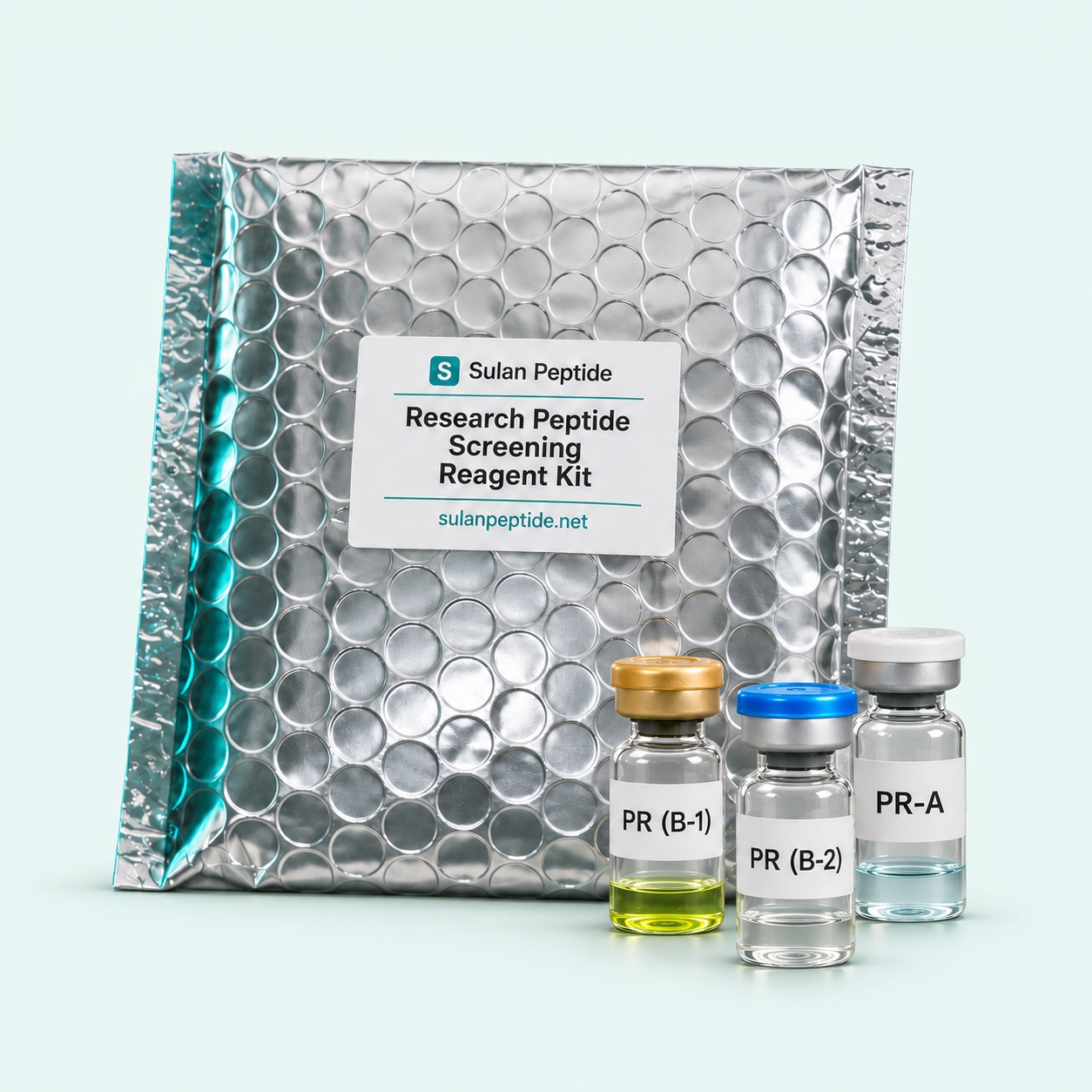
This demonstration shows the reagent steps and example color responses. Color patterns are preliminary screening observations, not confirmation of a sample’s molecular identity.
The supplied instructions describe two different procedures: Reagent A is used for a general backbone screen, while B-1 and B-2 are used together to compare category response patterns. The instructions do not say that one result confirms the other.
Test A · General screen
Reagent A
Purpose: preliminary indication of a peptide backbone.
Use the prepared research sample described in the kit insert.
Add 0.2–0.5 mL of sample (guide concentration: approximately 10 mg/mL) to Reagent A.
Wait about 30 seconds and record the observed color.
The guide describes a color response as an initial screening observation only.
Test B · Paired category screen
Reagents B-1 + B-2
Purpose: compare a sample’s color response with the kit’s listed category patterns.
Add 0.2–0.5 mL of prepared sample to colorless Reagent B-2 and gently mix.
Add pale-yellow Reagent B-1 to the B-2/sample mixture.
Observe and compare the result with the supplied response guide.
B-1 and B-2 are used together in this order; the guide does not specify a separate timed wait for this step.
In short: Test A = general backbone screen. Test B = add the sample to B-2, then add B-1 to compare a category-response pattern. These are distinct preliminary screens; neither confirms molecular identity.
This newly introduced screening workflow was jointly produced by Sulan Peptide and a laboratory partner. The quantities and observations above summarize the supplied instructions. Product-specific sensitivity, specificity, and detection-limit data were not included in the materials provided for this page. Always follow the current kit insert and applicable laboratory safety procedures.
Supplier-provided response guide
Example color patterns listed in the instructions
These examples describe the guide’s stated responses for the B-1/B-2 category screen. Color similarity alone does not identify a compound.
How to read these results
These are patterns listed in the supplied instructions. Similar colors do not establish that a sample is a named peptide, and a lack of visible change does not alone establish that a sample is counterfeit.
Sample profile in the guide
Listed response
Interpretation
RT profile (Retatrutide)
Very deep navy / ink blue
Pattern listed in supplied instructions; screening indication only.
TR profile (Tirzepatide)
Medium-deep navy
Pattern listed in supplied instructions; screening indication only.
TSM / CJC profiles
Deep blue
Pattern listed in supplied instructions; screening indication only.
BPC-157, TB-500, GHK-CU, KPV, MOTS-C, Epithalon, and Ipamorelin profiles
No visible change is listed
A non-response is not, by itself, proof of a counterfeit sample.
Where preliminary screening fits
A first look is not a laboratory confirmation
This kit is designed as an accessible first-pass observation for research workflows. It helps users decide whether a sample merits further review; it does not produce the analytical evidence needed to establish peptide identity or purity.
What is distinctive about this kit: its supplied guide combines a general Reagent A backbone response with a paired B-1/B-2 category-response comparison. This is a visual pattern-screening workflow, not a peptide concentration assay. Commercial colorimetric peptide products can have a different goal; for example, Thermo Scientific describes its Pierce product as a quantitative assay for peptide mixtures, with product-specific sample and method limitations.
01 · Preliminary observation
This reagent kit
Visual color patterns from the supplied A and B reagent procedures. Use only as an initial screening signal under the stated instructions.
02 · Chromatographic analysis
HPLC / chromatography
Can separate a peptide from some related components and support purity or comparison assessments when a suitable, validated method and reference materials are used.
03 · Molecular characterization
Mass spectrometry and orthogonal methods
Mass spectrometry can support molecular-mass and sequence characterization. Peptide identity assessments may require suitable complementary methods; no single visible color result provides that confirmation.
Industry context: the European Medicines Agency’s synthetic-peptide guideline recommends orthogonal methods for peptide identification and lists approaches such as LC-MS, peptide mapping, amino-acid analysis, and NMR. That guidance concerns peptide characterization; it does not validate this screening kit.
These references describe general peptide-analysis context and a separate commercial quantitative assay; neither evaluates or endorses this product.
Product questions
Frequently asked questions
What is the difference between Reagent A and Reagents B-1/B-2?
Reagent A is described as a general peptide-backbone screening step: add the prepared sample to Reagent A and observe the color after about 30 seconds. Reagents B-1 and B-2 are a paired, category-response screening step: add the sample to colorless B-2 and gently mix, then add pale-yellow B-1 and compare the resulting color with the supplied guide. Neither step confirms molecular identity or purity.
Does this kit prove that a peptide is authentic?
No. It provides preliminary color-response screening only. It cannot confirm a specific molecular identity, purity, concentration, or contaminant profile.
Can this kit replace HPLC or LC-MS?
No. The supplied instructions explicitly state that it cannot replace precise instrumental analysis. Use appropriate validated laboratory methods when confirmation is required.
How is this different from a quantitative colorimetric peptide assay?
This kit’s supplied guide describes visual preliminary screening patterns using Reagent A and paired Reagents B-1/B-2. Some commercial colorimetric peptide assays are designed to estimate peptide-mixture concentration under specified assay conditions. Those are different stated purposes. This screening kit is not a quantitative concentration assay, and a color response from either type of assay should not be treated as proof of a specific peptide identity.
Was this kit produced with a laboratory partner?
Sulan Peptide describes this newly introduced kit as jointly produced with a laboratory partner. The product materials supplied for this page do not name the partner or provide independent validation data, sensitivity, specificity, or detection limits.
What sample amount and observation time are listed?
The supplied instructions describe 0.2–0.5 mL of sample at approximately 10 mg/mL and an approximately 30-second observation for Reagent A. Follow the current kit insert for the applicable procedure.
Is this kit for home, clinical, or human diagnostic use?
No. The supplied product instructions state that it is for laboratory research screening only and is not for clinical use, human diagnosis, or commercial qualitative arbitration. Avoid direct skin or mouth contact and store the reagents away from light at room temperature.